
avatar
Telegram Contest - Diego Longo
@diegolongotelegramcontest
16.12.2025 22:59
Telegram Contest - Diego Longo Telegram Contest 2025 - Diego Longo - Ios Light mode mockups - Ios Dark mode mockups - Android Light mode mockups - Android Dark mode mockups - Demo Video - Figma Board Rationales I followed The brief was to create separate instances within the app, like Slack workspaces. Discord Servers are also mentioned in the brief, and I leaned more toward that direction for several reasons. As for the user scenario, having completely separate instances (so private 1-on-1 chats in all spaces, possible duplicates, etc.) is only useful in corporate contexts, where all communications must remain internal. I believe Telegram would benefit from greater flexibility, to provide tools for different types of aggregation. For this reason, I designed Nodes as servers with various types of chats inside, but not 1-on-1 chats. The Node organization is centralized, like Discord (the channel tree is the same for all), however, the user can select specific chats and add them to their personal chats, as shortcuts, to organize them as folders. This way, Nodes always remain well-organized, unlike an approach like Slack, where users pull channels from a repository and organize them in their workspace. If there are frequently used chats, users can create shortcuts in their Telegram Inbox. I also chose this approach for platform reasons: Telegram is designed as mobile-first, unlike Slack. On desktop, it's easy to create a horizontal layout to create separate workspaces, while on mobile, regardless of the chosen interaction, it would be unintuitive to have to switch app instances every time, favoring the inbox over the Node or vice versa. This is why I believe a hybrid approach is best for Telegram: Nodes are in the tab bar like the Inbox (moving call history and less-used contacts to the profile), but they are organized centrally, to offload the organizational burden to the user, who already uses folders to organize their life. This does not change the fact that, like Discord, it is possible to set a profile picture and nickname for each Node. To enhance the Node aggregation experience, I focused on two additions: Stories, which allow anyone to see the stories of all Node members, sorted algorithmically by number of interactions, boosting the intent to share content, and Nodes Squares, widgets that admins enable to give the community an extra boost: rooms, leaderboards, maps, pinned documents, user matchers—there's no shortage of design options. Regarding Stories, I've also designed automatic Stories that extract trending content, such as posts with comments, and temporarily place it in a story. For large communities, this would be a great tool for browsing new content while directly seeing what's happening in the community. Furthermore, the pattern reminds users of stories they can use to get noticed within the community.
avatar
Telegram Contest - Diego Longo
@diegolongotelegramcontest
16.12.2025 19:08
Rationales I followed

The brief was to create separate instances within the app, like Slack workspaces.
Discord Servers are also mentioned in the brief, and I leaned more toward that direction for several reasons.

As for the user scenario, having completely separate instances (so private 1-on-1 chats in all spaces, possible duplicates, etc.) is only useful in corporate contexts, where all communications must remain internal. I believe Telegram would benefit from greater flexibility, to provide tools for different types of aggregation.

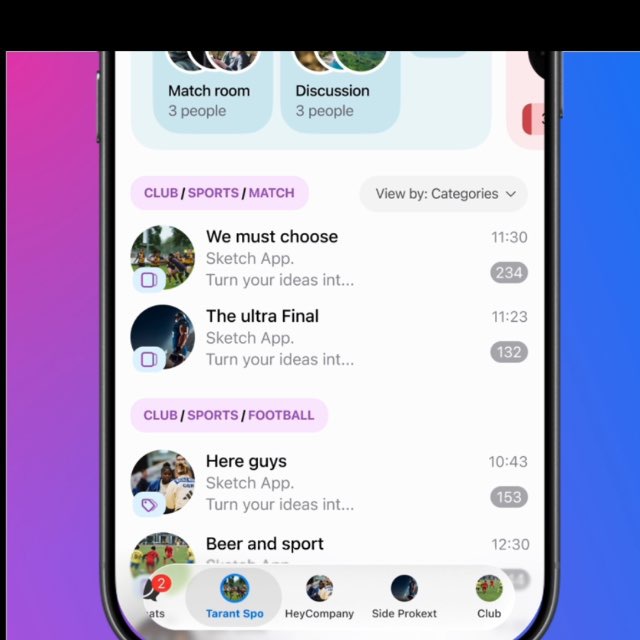
For this reason, I designed Nodes as servers with various types of chats inside, but not 1-on-1 chats. The Node organization is centralized, like Discord (the channel tree is the same for all), however, the user can select specific chats and add them to their personal chats, as shortcuts, to organize them as folders.
This way, Nodes always remain well-organized, unlike an approach like Slack, where users pull channels from a repository and organize them in their workspace. If there are frequently used chats, users can create shortcuts in their Telegram Inbox.

I also chose this approach for platform reasons: Telegram is designed as mobile-first, unlike Slack. On desktop, it's easy to create a horizontal layout to create separate workspaces, while on mobile, regardless of the chosen interaction, it would be unintuitive to have to switch app instances every time, favoring the inbox over the Node or vice versa.

This is why I believe a hybrid approach is best for Telegram: Nodes are in the tab bar like the Inbox (moving call history and less-used contacts to the profile), but they are organized centrally, to offload the organizational burden to the user, who already uses folders to organize their life. This does not change the fact that, like Discord, it is possible to set a profile picture and nickname for each Node.

To enhance the Node aggregation experience, I focused on two additions: Stories, which allow anyone to see the stories of all Node members, sorted algorithmically by number of interactions, boosting the intent to share content, and Nodes Squares, widgets that admins enable to give the community an extra boost: rooms, leaderboards, maps, pinned documents, user matchers—there's no shortage of design options.

Regarding Stories, I've also designed automatic Stories that extract trending content, such as posts with comments, and temporarily place it in a story. For large communities, this would be a great tool for browsing new content while directly seeing what's happening in the community. Furthermore, the pattern reminds users of stories they can use to get noticed within the community.
4 367

Telegram Contest - Diego Longo

9
Открыть в Telegram